

In 1999, professors R. W. Connell, Jorunn Solheim and Dag Østerberg evaluated my research. The main part of their evaluation is presented below.
Competence evaluation of Øystein Gullvåg Holter (excerpts)
“March 1999
“Øystein Gullvåg Holter applied in December 1997 for a competence evaluation as researcher I (professorial level) at the Work Research Institute. On the basis of the application an evaluation committee was appointed in February 1998, consisting of:
professor Dag Østerberg, Oslo
professor Robert Connell, University of Sydney
professor Jorun Solheim, The Work Research Institute, Oslo (WRI)
The recommendations of the committee are unanimous.”
“The evaluation has been conducted in accordance with the WRI rules for competence evaluation. These rules state that the competence level for a researcher I-position shall be comparable to that of a university professor.”
“As a scholar, Øystein Gullvåg Holter has produced an extensive amount of publications. His CV consists of 13 book titles or more extensive publications, and about 90 papers. The overall scope of the entire production is quite remarkable. The work covers a broad field of theoretical as well as empirical research”.
Evaluation of selected publications
Gender, Patriarchy and Capitalism. A Social Forms Analysis
“This is Holter’s doctoral dissertation, submitted for the dr. philos. degree at the University of Oslo, october 1997. The thesis is an extensive attempt to integrate a theory of patriarchy with an analysis of gender and economic relations.”
“It is without doubt an important work of scholarship, and probably one of the most sophisticated attempts yet to integrate a theory of patriarchy with the analysis of gender and capitalism. A particular strength is the extraordinary scope of the analysis, the inclusiveness of the theoretical argument, and the interweaving of theoretical analysis with empirical research. It is also a highly original and innovative work.” “At the same time, the dissertation presents several difficulties (..) the work presents itself as too much of an enigma to the reader (..) it is exploring rather than systematic.”.
“The overall impression of the thesis is that of a highly original and inventive contribution to social theory. The work has great potential, and should, given a further treatment in the direction of a more accessible and less all-inclusive argument, deserve wide recognition. The committee can therefore without difficulty endorse the former doctoral committee’s unanimous acceptance of Holter’s dissertation.”
Family Theory Revisited
“The paper is a fine contribution in the genre Holter is very good at – the reconfiguration of a field of ideas, based on an assembly of detailed empirical studies.”
Work, Gender and the Future
“The paper is well-formulated, reads clearly, and shows Holter’s ability to condense and translate complex issues into a clear argument, without losing sight of the intricacies of this complexity.”
Catering for the Oil
“An instructive and well written piece of industrial sociology, which describes and analyses working life and work conditions on Norwegian offshore oil platforms.” “As an integrated study on the structure of work, labour processes and community formation it has great merit, and it also testifies to Holter’s skill as an empirical researcher.”
Men’s Life Patterns (Menns livssammenheng)
“The text conveys stongly the contradictory elements of emotional relations which characterize men in contemporary family/work settings, and nicely complements the more economic focus in other works.”
Authoritarianism and Masculinity
“Strongly confirms the relevance of authoritarianism for contemporary social research, making the paper an admirable case of ’continuity in research’. The paper deserves publication for a much wider audience”.
Conclusion
“Taken together, these texts may be said to constitute the work of an exceptionally versatile sociologist on a high academic level. They document an unusual capacity for intellectual synthesis and mastery of a range of research methods and styles. Through these texts, Holter comes across as a very competent scholar, who combines theoretical brilliance with a deep concern with the practical relevance of social science.”
“A common requirement for awarding professorial competence, is that the candidate should have an academic production comparable to two doctoral dissertations. Even if these requirements are not always taken literally, the committee find that they should not pose any problem in this case. Taken together, the group of publications submitted apart from the dr. philos thesis, make up a body of work that combines the theoretical scope and empirical content equivalent to another ’dissertation’. Added to the doctoral thesis, these works should therefore, in the committee’s judgement, be quite sufficient to confer upon Øystein Gullvåg. Holter the required professorial competence.”
“The committee finds that Øystein G. Holter without doubt meets the specific WRI requirements for researcher I competence, and that he is very well qualified for such a position.”
Oslo/Sydney 8.3. 1999
Dag Østerberg Robert W. Connell Jorun Solheim
(sign.) (sign.) (sign.)
It is only recently that I have found a 2006 publication of the Radical economy network (RØST) in Norway. This is an anthology with excellent contributions from economists like Charlotte Koren, Hilde Bojer and Erling Barth. In my view, it mainly shows the relative negligence of material and economic approaches, even in the Norway welfare state development.
The welfare state proponents tend to argue that gender inequality is not their doing. It only came along due to tradition. Realities were different.
“When the results of the first time use study came in the middle of the 1970s and showed that the work input was of a similar size as the industrial work input, my male colleagues in Statistics Norway laughed at me in a rejecting way. Everyone knew that women who were at home did nothing, so this had to be wrong” (Koren 2007: 27, my trans).
See:
Charlotte Koren, Husholdsarbeid [Household work]. In: Clarhall, Jenny; Stensbak, Helle, eds 2006: RØST: Kvinner og cash 2006-01 [Women and cash], Radikalt økonominettverk (Network of radical economists), c/o For velferdsstaten, Oslo, www.okonominettverket.no
Evidence is building up in support of a critical materialist view of gender inequality. Already in 2008, a Norwegian parliamentary report concluded that the wage gap between the genders had scarcely changed, over the last three decades – despite a lot of other change, regarding gender (NOU 2008:6 Kjønn og lønn).

(Norwegian 2008 report cover – illustrating the gender gap in wages)
In 2010 a Nordic region comparison of gender equality in politics and the economy found much greater change in politics. The more private the economy, the lower the degree of gender equality (Niskanen etc 2010).
Now, international reports confirm the picture.
The new Global Gender Gap Index report 2014 shows changes over the nine years since the index was first made in 2006. While politics shows a rapid pace of change (although starting from a lower level of gender equality), the economy shows almost a standstill. Women’s share of earnings, for example, has not increased (WEF 2014).
A new OECD report concludes that “despite political statements about the importance of women’s economic empowerment, donor investments in women’s economic empowerment have remained flat and unchanged since 2007. Out of a total of USD 5.5 billion on average per year to women’s economic empowerment in 2011 and 2012, only USD 469 million targeted gender equality as a principal objective. This represented a low 2% of the bilateral aid going to women’s economic empowerment. There is a gap between what donors say they do and what they are actually doing” (OECD 2014:2).
References
NOU 2008:6 Kjønn og lønn. Fakta, analyser og virkemidler for likelønn [Gender and wages. Facts, analyses and methods for gender-equal wages] NOU 2008:6 [parliamentary report]. Departementenes servicesenter, Oslo
Niskanen, Kirsti; Nyberg, Anita eds: Køn och makt i Norden [Gender and power in the Nordic region]. Del 2: Sammanfattande diskussion och analys. Nordisk Ministerråd, København 2010.
WEF 2014: The global gender gap report 2014, cf. http://reports.weforum.org/global-gender-gap-report-2014/report-highlights/
OECD 2014: Financing the unfinished business of gender equality and women’s rights: priorities for the post-2015 framework. OECD DAC Network on Gender Equality, OECD (internet publication, March 2014)
http://www.oecd.org/dac/gender-development/Short%20version%20-%20FINALFinancing%20the%20unfinished%20business%20of%20gender%20equality.pdf
In Norway, now, there is a debate on sick leave – why is it so much higher for women, than for men.
A new report finds that divorce has a big effect on sick leave, especially at the time of the divorce, but later also. The long term higher sick leave effect of breakup or divorce is largest among women with children (Bakken, Jonas Blich; Haug, Anne Kari: Blir syke av skilsmisser. Dagens Næringsliv 15.11.14).
Much of this new empirical picture was shown already in a 2006 survey (Foreningen 2 Foreldre – Synovate MMI: Sorg uten blomster. En undersøkelse av omfanget av sykefravær og annet fravær ved samlivsbrudd [Sorrow without flowers. A survey of the extent of sickness leave and other leave in couple relationship break-ups]).
The 2006 survey showed that breakups and divorces are costly, in psychosocial terms, and also in economic terms, for employers. It was also found that many of the target respondents had trouble responding; they felt so bad about the breakup.
Interestingly, this exploratory survey – 8 years before the more “mainstream” research now reported in the media – was created through the initiative of what had in many ways been a father’s right group (Foreningen 2 foreldre [The two parents association]), now turning the critical flashlight from bad mothers to the costs of divorce.
This came about through the intervention of the Gender equality center, at my proposal, to get the children’s rights associated NGO organisations to talk together, regardless of their differences.
At the meeting at the Gender equality center, the mother’s organization (Aleneforeldreforeningen [The single parent association]) and the two parent association were present. I argued that if mother organizations and father organizations just quarrel, we will never get further, so instead we should focus on what is common for all – a concern for the child. This strategy paid off. Instead of just attacking unreasonable mothers, the fathers’ association created an innovative agency: let us look at what divorces actually imply.
This approach got support from the employer’s union. Thereby a survey was made in 2006 that in many ways predicts the new 2014 study results. I was part of the advisory group of the 2006 study, along with other experts like the psychologist Frode Thuen.
A new study of attitudes to gay rights has been published, with more coverage than before, combining data from several international surveys and country statistics. The report shows that generally, gay rights have gained some more acceptance over the last decades, but the main picture is one of strong global variation.
Testing for predictors of attitudes to gay rights, the researchers found that attitudes are more positive in richer countries and less conservative religious countries (but more negative in post-socialist than other European states). Generally, higher education, lower age, and female gender predicted more positive attitudes to gay rights.
The study included testing for income, education, religion and other variables – but strangely enough, no social equality variable was included. Income equality (like the Gini index) and gender equality (like the Gender gap index) are missing in action, so to speak.
I checked this for Europe, using the Gender Equality Statistics database (see Holter, Ø 2015), including a gay acceptance measure from the Gallup world poll: Is the city or area where you live a good place or not a good place to live for gays and lesbians?
Result:
| Correlations | |||
| Good place to live for gays lesbians (Gallup 2013) | Gender gap index inc US states | ||
| Good place to live for gays lesbians (Gallup 2013) | Pearson Correlation | 1 | ,603 |
| Sig. (2-tailed) | ,001 | ||
| N | 28 | 28 | |
| Gender gap index inc US states | Pearson Correlation | ,603 | 1 |
| Sig. (2-tailed) | ,001 | ||
| N | 28 | 116 | |
Among 28 European countries, there is a .60 correlation between gender equality and that the area is a good place to live for gays and lesbians. This is very strong.
Of course these numbers by themselves say nothing about what causes what, but historically, there is little doubt that gender equality has helped pave the way for gay/lesbian acceptance and rights.
Therefore, gender equality and other forms of equality should be included, in models trying to explain gay, lesbian and trans acceptance. Other variables that probably would help develop these models include quality of life, and social trust and cohesion.
This is also a theory issue. Is gay acceptance and rights explained mainly by tradition, culture and religion? Or are there also more “sociological” forces at hand, causing changes in acceptance? Many theories to this effect exists, especially, theories of how gays and other “outgroups” can become scapegoats for wider system problems.
If we look at historical developments over the last hundred years, it is not religion per se that creates the well-known tendency of authoritarian regimes to deny gay rights. Rather it is part of the working of the authoritarian system. In tendency, gay rights and gender equality disapper – across very different regimes like Stalinist Russia, Nazi Germany, communist China, non-democratic Moslem states, etc. Gays (and to some degree, lesbians) become scapegoats, embodying a kind of freedom that the regime does not want, their rights declining in societies with rising authortarianism, inequality and conflict. If social inequality becomes large, others will have to suffer, as a system tendency – and this will hit on gays and other outcasts.
Besides income, education, less fundamentalist religion etc there are probably two main factors contributing to gay rights – class equality and gender equality. Ethnic equality is probably important too – racism and homophobia are well-known twins in social science. Possibly, gender equality is the most important of these factors, at least in a direct sense, since gender equality is the type of social equality that is most closely connected to sexuality.
This is a very important research area and hopefully, new research will be funded, to tell us more.
Even if gender equality historically has paved the way for gay rights, at some stages, the cause and effect may be different. In a superficial view, gay rights only concern a small minority. Yet it concerns very important majority freedoms too. In some contexts, gay lesbian and trans rights may be crucial gender equality issues, even more than the “traditional” majority issues.
Further reading
New gay acceptance study:
http://williamsinstitute.law.ucla.edu/wp-content/uploads/public-attitudes-nov-2014.pdf
Gender equality statistics data base:
Holter, Øystein Gullvåg 2015: “What’s in it for men” – old question, new data. Journal of men and masculinities (in print)
Gallup world poll:
http://www.gallup.com/poll/175520/nearly-worldwide-areas-good-gays.aspx
Authoritarian regimes, aggression and gender related discrimination:
Holter, Øystein Gullvåg 2004: A Theory of Gendercide. In Jones, Adam, ed.: Gendercide and genocide. Vanderbilt University Press, Norman, p 62-97
Project kickoff seminar Oslo Dec 5-6 – more to come.
I am reading “Bloodlands: Europe Between Hitler and Stalin”, where the American historian Timothy D. Snyder creates a convincing and new portrait of what the World War 2 was mainly about. Perhaps it does not “change our view of the 20th century” but it is certainly interesting reading, even for a reader who already has a couple of shelf meters of literature on World War 2 and has for long understood that the eastern front was decisive. Snyder laconically tells of death numbers, this can be a bit repetitive, it takes a while before the message sinks in. He shows the suffering of Poland, right in the middle of the “bloodlands”.

From the Nazi side, this was a race war, Snyder reminds us, not just a geographical war. And especially, it was changed into a race war, as the geographical war did not succeed. Victory over the Jews through the holocaust became the absurd “answer” of the Nazi regime to the lack of real war victories. Snyder makes a good point here. He calls it “surrogate victory”. He also makes a good point that Hitler was able to learn from the already established Stalinist killing methods, although he could have added other sources of inspiration also, including British methods of subordination, perhaps American. The Nazis generally were willing to learn from anyone regarding killing.
Perhaps Snyder overdoes the Stalin-Hitler connection a bit, although he wisely does not move into a conspiracy terrain. These were different social processes, even if they both ended up with unheard-of numbers of dead people. Ann Applebaum in Gulag – a history draws a line between a system that kills people on and off, like the Gulags, and a system designed for death, like the Nazi Holocaust, and she is right in my view. What Snyder contributes is evidence of extensive politically motivated murdering in the Soviet Union long before Hitler had much power to kill in Germany. People were not just put into Gulags, many were shot, with quota methods. Death by starvation was used as a method, whole regions could be starved to death.
Snyder’s portrait of Stalinist policy from the early 1930is is frightening, confirming the reports of Victor Serge (The Course is Set on Hope, described elsewhere on this site, writing about the great terror at the time.
Ironically, the evidence is also much in line with Marx’s theory (e.g. in Grundrisse and especially in “Results of the Immediate Process of Production”, appendix to Capital Vol. 1, Penguin, Harmondsworth 1978) regarding how modern power systems develop. They develop socially, before they become industrial – in Marx’s terms: formal and real subordination. Snyder’s new evidence on extensive Stalinist shootings fills out Applebaum’s Gulag evidence at this point. As more people were shot, the Gulag inmate status sunk from “erring comrade” to “enemy” and from there to “vermin”.
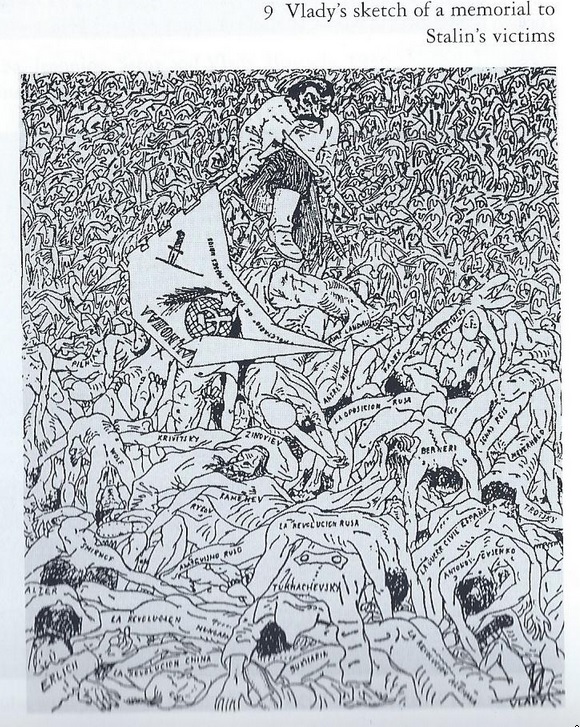
Here is a Vlady Serge (Victor Serge’s son) drawing from this book. This figure sums up Snyder’s new work regarding “socialist” Russia long before today’s historians could get the material. Snyder rightly calls the mass murder a counter-revolution.
The artist, Vlady Serge:

I 2007 ledet jeg en undersøkelsesundersøkelse kalt “Likestilling og livskvalitet” i Norge (med Helge Svare og Cathrine Egeland).
Det var en “state of the art” type detaljundersøkelse av kjønn i / likhet. Nasjonalt i Norge ble det brukt i politiske dokumenter som hvitboken om menn (Mannsmeldingen) og av likestillingskommisjonen (Skjeie-utvalget). Internasjonalt spredte det seg mye mer enn vanlig, spesielt i (delvis norskfinansierte) BILDE-undersøkelsen rundt om i verden: https://promundoglobal.org/programs/international-men-and-gender-equality-survey-images/#
Basert på denne ganske uvanlige internasjonale oppkjøringen for en norsk forskningsmodell, hadde jeg håpet at i 2017, ti år etter den opprinnelige undersøkelsen, ville Norge finansiere en oppfølging, men at det ikke skjedde, til tross for litt lobbyvirksomhet fra min side (ikke vanlig for meg, men jeg trodde at dette var av nasjonal betydning). Det ble til og med ført opp i parlamentet / Stortinget, men fikk ikke finansiering, så jeg trengte å bruke billig lån med lav rente for å få hjelp til virksomheten min.
Norges forskningsråd var med på å få en mer begrenset utvikling til virkelighet. Et Polen-Norge-prosjekt ble finansiert under EØS-bevilgninger, med samme tittel som det originale norske prosjektet i 2007.
Nå er hovedresultatene fra den nye studien publisert på polsk, samt en første mer teoretisk oversikt, på engelsk.
Polen-Norge-versjonen av studien prøvde å gå utover IMAGE-versjonen, som var noe “anvendt” og fokusert på menn og vold. Den siktet mot rom norgesiden) var å og forbedre den grunnleggende “strukturelle / kulturelle” norske designen – en mer dyptgående tilnærming til likestilling. Oppgaven var å utvikle en modell for kjønn i / likestilling som fungerte bra også i Polen. Forskerteamene samarbeidet for å lage et mer helhetlig likestillingsmålingsinstrument enn tidligere har vært tilgjengelig i Europa. Det ble foretatt en representativ undersøkelse i Polen 2015, samt intervjustudier.
Her er den første boken fra prosjektet, på engelsk:

The second book (2018), with results, in Polish;

Basert på forskningserfaring og sammenligning mellom Polen og Norge, samarbeidet de to teamene også for å lage en “blåkopi” -versjon for en forbedret undersøkelse – på engelsk – som går utover Polen / Norge-rammen, som kan brukes i videre forskningsutvikling, for eksempel for en kartlegging av Europa som helhet.
Blueprint-forslaget finner du her:
The idea is to go one step further – for more research;

This paper examines new data on how gender equality affects interpersonal violence. Link to paper here.
My 1997 dr. philos. thesis “Gender, Patriarchy and Capitalism – A Social Forms Analysis” has now been transferred from my old web page.
Due to size, it is published in two parts.
Part one includes my research areas and the main analysis of today’s gender system, along with a first version of social forms analysis. Part two contains extensions of this first version, going into patriarchy theory, historical evidence, economic evidence, and others.
Some errors remain. Please note, some figures etc. have not been copied, text is sometimes incorrectly formatted, etc. Also, note the Errata list at the end of part 2.
